





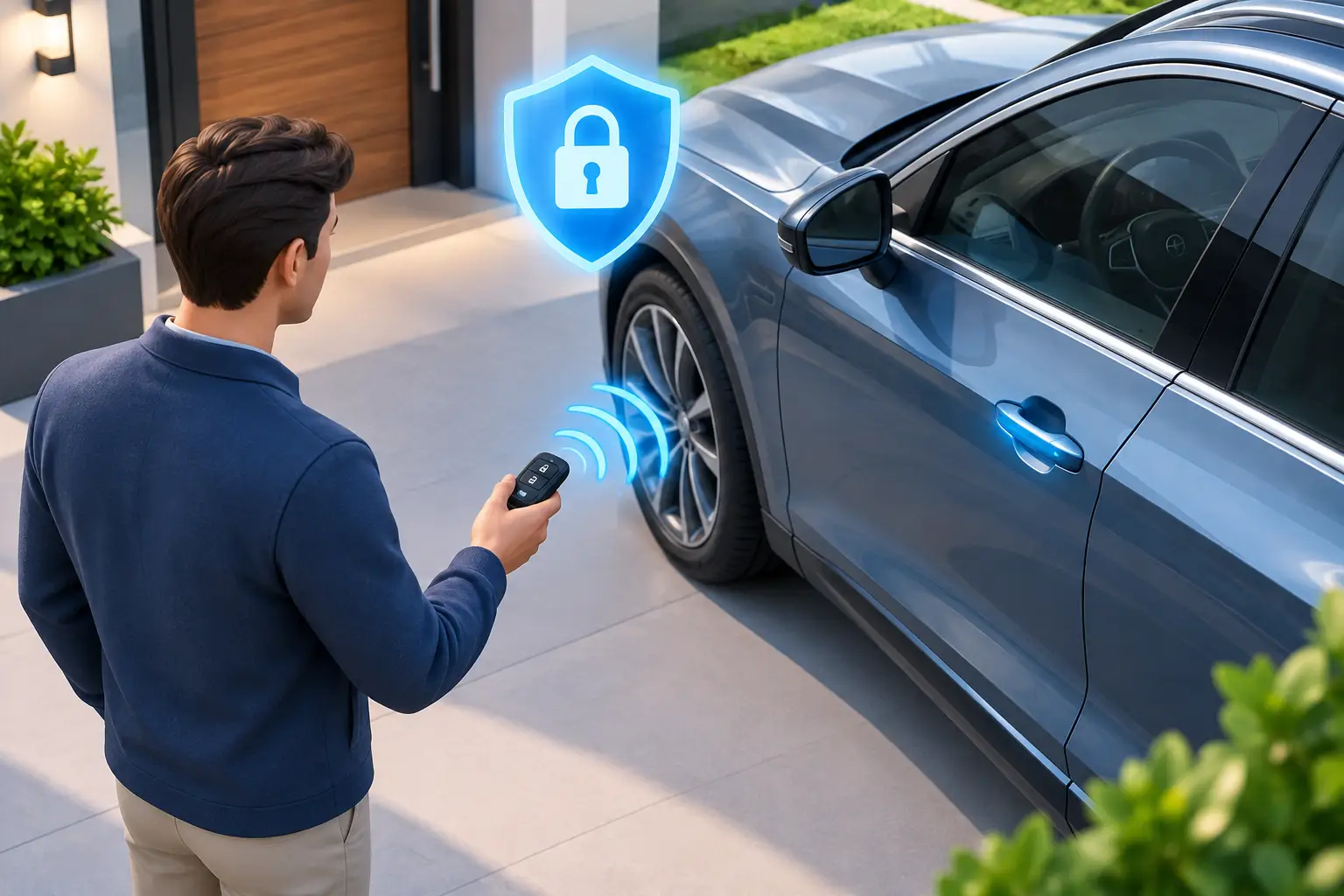
Your smart key is supposed to make getting into your car easier, not give criminals an easier route in. This guide to keyless entry security explains the real risks behind modern vehicle fobs, what practical protection looks like, and when a key issue needs professional attention.
Keyless entry systems are highly convenient. Your vehicle recognizes an authorized fob, lets you enter without pressing a button, and may allow push-button starting once the key is inside. Most current systems also use encrypted communication and changing codes, which makes simple copying far harder than it was with older remotes. Still, convenience creates a few security decisions for drivers to manage.
How Keyless Entry Security Works
A modern smart key is more than a remote control. It contains an electronic chip that communicates with the vehicle's immobilizer and keyless-entry system. When you press a button or approach a vehicle with passive entry enabled, the car checks whether the key is authorized before it releases the locks or permits the engine to start.
For many Toyota and Lexus models, the key's electronic identity is tied to the vehicle's security system. A metal emergency key can open a door mechanically, but it generally cannot start the vehicle without a correctly programmed transponder or smart key nearby. That separation is a meaningful layer of protection.
The details vary by year, trim, and model. Some vehicles let owners disable passive entry or adjust automatic locking settings. Others have a separate feature for starting the car if the key battery is weak. Your owner's manual is the best place to confirm what your vehicle can and cannot do.
The Real Risks to Your Keyless Entry System
A lost fob is the most direct risk. If someone finds it along with information that identifies your vehicle or home address, they may know exactly what it opens. A missing key should never be treated like a lost house key that might turn up eventually. The electronic key needs to be removed from the vehicle's authorized-key memory as soon as possible.
Relay theft is another concern, especially with passive-entry vehicles. In this type of theft, criminals use devices to extend the signal between a vehicle and a nearby key fob. They are not necessarily breaking the encryption or making a true copy of the key. Instead, they are making the car believe the authorized key is close by when it is actually inside a house, office, or nearby building.
That distinction matters because the right defense is usually simple signal management, not panic about every smart key being easily hackable. Modern encrypted systems are designed to resist ordinary cloning. Relay attacks take proximity, timing, equipment, and opportunity.
There is also a lower-tech problem: accidental access. Leaving an unlocked fob in an open bag, lending a car without tracking who has the spare, or buying a used vehicle with unknown key history can all create avoidable uncertainty. Security is not only about electronics. It is about knowing who has access.
A Guide to Keyless Entry Security at Home
Where you store your key at night makes a difference. Avoid leaving it on a table, shelf, or hook directly beside an exterior wall, front door, or garage door. Moving it farther into the home reduces the chance that a relay device can reach it from outside.
For vehicles with passive entry, a signal-blocking pouch or box can add another layer of protection. These products are often called Faraday pouches or Faraday boxes. Test one before relying on it: place the fob inside, stand next to the vehicle, and confirm that the doors do not respond. A pouch with worn seams or poor construction may not block the signal consistently.
A pouch is useful, but it is not the only answer. If your vehicle lets you turn off passive entry while keeping button-operated locking, that may be a good option for drivers who park on the street or near a public sidewalk. The trade-off is convenience. You may need to press the lock or unlock button instead of walking up and touching the handle.
If you have a spare key, store it intentionally. Do not leave it in the glove box, center console, wheel well, or magnetic hide-a-key box. Those locations are predictable, and a spare inside the vehicle can defeat the point of locking it.
Protect the Fob You Carry Every Day
Your working key needs physical protection as well as electronic protection. Avoid attaching a tag with your full name, address, license plate number, or vehicle identification information. If the fob is lost, that information helps the wrong person connect the key to the car.
A damaged fob case can also create problems. Cracked shells, loose buttons, water exposure, and weak battery contacts can cause intermittent signals that look like a programming problem. Replacing a worn shell or repairing the remote before it fails completely can save time when you need to get to work, pick up family, or complete rideshare trips.
Replace the battery when range becomes inconsistent, the vehicle displays a key-battery warning, or the buttons require repeated presses. Use the correct battery type and install it in the proper orientation. A weak battery does not normally erase programming, but it can leave you locked out of convenient features at the worst possible time.
It is also smart to keep the emergency mechanical key accessible. Many smart fobs include a hidden insert key for entering the vehicle if the fob battery dies. Learn how to remove it before an emergency, not while standing in a dark parking lot in bad weather.
Be Careful With Replacement and Used Keys
Not every key sold online is ready to start your vehicle. A key may need cutting, programming, or both. It may also be the wrong frequency, wrong chip type, or wrong part number for your exact model year. A remote that looks identical can still fail to communicate with the vehicle.
Used smart keys deserve extra caution. Some can be refurbished for certain applications, while others cannot be reliably reused without specialized processes. There can also be issues with previous programming or compatibility. The lowest-priced fob is not always the lowest-cost solution if it leaves you paying twice for programming or troubleshooting.
When ordering or programming a replacement, have the vehicle make, model, year, and vehicle identification number available. A qualified automotive key specialist can use that information to verify compatibility and explain whether the key needs an emergency blade cut, immobilizer programming, remote programming, or all three.
What to Do If a Key Is Lost or Stolen
If your key is missing and you cannot confirm it is safely inside your home, act quickly. First, secure the vehicle and remove valuables. Then arrange to have the missing key deleted from the vehicle's memory and a replacement programmed. If all keys are lost, the vehicle may need an all-keys-lost service process, which can include creating and programming new authorized keys at the vehicle's location.
Do not assume that buying another fob automatically makes the lost one useless. If the old fob remains programmed, it may still be able to unlock or start the vehicle. The important security step is removing it from authorization.
For a used car with only one key, adding a second working key is more than a convenience purchase. It prevents a single lost or damaged fob from becoming an emergency and gives you a chance to confirm exactly how many keys are authorized to the vehicle.
When to Call a Key Security Specialist
Call for help when a key was stolen, a previously lost key reappears, your vehicle was purchased with uncertain key history, or you suspect an unauthorized key may have been programmed. You should also get assistance if a fob works only sometimes, the car says it cannot detect the key, or you need a duplicate that will operate both the remote functions and immobilizer correctly.
Smartkeys can verify the right key type, cut emergency keys, program compatible smart keys and transponders, and help remove lost keys from a vehicle's authorized memory. Mobile service is especially helpful when the vehicle cannot be started or moved.
A keyless system should make your daily drive easier, not leave you guessing who can access your car. Keep track of every authorized key, store fobs thoughtfully, and address a lost or failing key before it turns into a roadside problem.